5 Things You Can Do Before You Even Call a Professional Organizer
Let’s be honest: not every messy space needs a professional organizer. Sometimes, you don’t need a full organizing session—you just need a little momentum, a few hours to yourself, and a place to start. And if you’re sitting there staring at a cluttered closet, overflowing kitchen counter, or playroom that looks like a toy store exploded, I get it. Sometimes the hardest part isn’t the organizing itself. It’s figuring out where to begin.
So if working with an organizer isn’t in the cards for you at this time, here are five things you can try on your own.
1. Start with trash, not treasure.
When we’re surrounded by clutter, we tend to jump straight into the big decisions. Should I keep this? Do I still use this? What if I need it someday? And suddenly, you’ve spent 45 minutes holding onto a shirt you haven’t worn since 2016.
Let’s make this easier. Start with the obvious stuff. Grab a trash bag and walk through the space looking only for things that are clearly trash, recycling, or no longer usable. Don’t worry about organizing yet, and don’t worry about making keep-or-donate decisions. Just remove the easy stuff.
You’ll be surprised by how much better a space can feel when you simply get the obvious garbage out of the way. Less visual clutter means less decision fatigue, and that gives you a much easier starting point.
2. Sort by category, not by room.
This one can be a game changer. When you organize room by room, it’s easy to miss the bigger picture. You might organize the kitchen cabinet and then discover three more boxes of mugs in the dining room. Or you might organize the closet without realizing you have shoes tucked into the guest room, hallway, and under the bed.
Instead, try organizing by category. Pull all of one type of item together—your shoes, mugs, towels, kids’ art supplies, cleaning products, or handbags, and put them in one place. Seeing everything together makes it much easier to answer the question, “Do I actually need all of this?”
You can’t make an informed decision about your stuff if you don’t know how much stuff you have.

3. Give everything a “maybe” box—with a deadline.
Not ready to get rid of something? That’s okay. You don’t have to make every decision immediately. If you’re genuinely unsure about an item, create a “maybe” box and put those things inside.
But here’s the important part: give the box a deadline. Maybe it’s 30, 60, or 90 days from now. Write the date on the box, put it somewhere out of the way, and go live your life.
If you find yourself digging through the box three weeks later because you suddenly need something, great—you have your answer. But if your deadline arrives and you haven’t thought about, looked for, or needed anything in that box, that tells you something, too. You may be ready to let those things go.
The goal isn’t to use the box as a permanent holding zone for things you’re emotionally avoiding. It’s simply a way to give yourself some breathing room while still moving toward a decision.
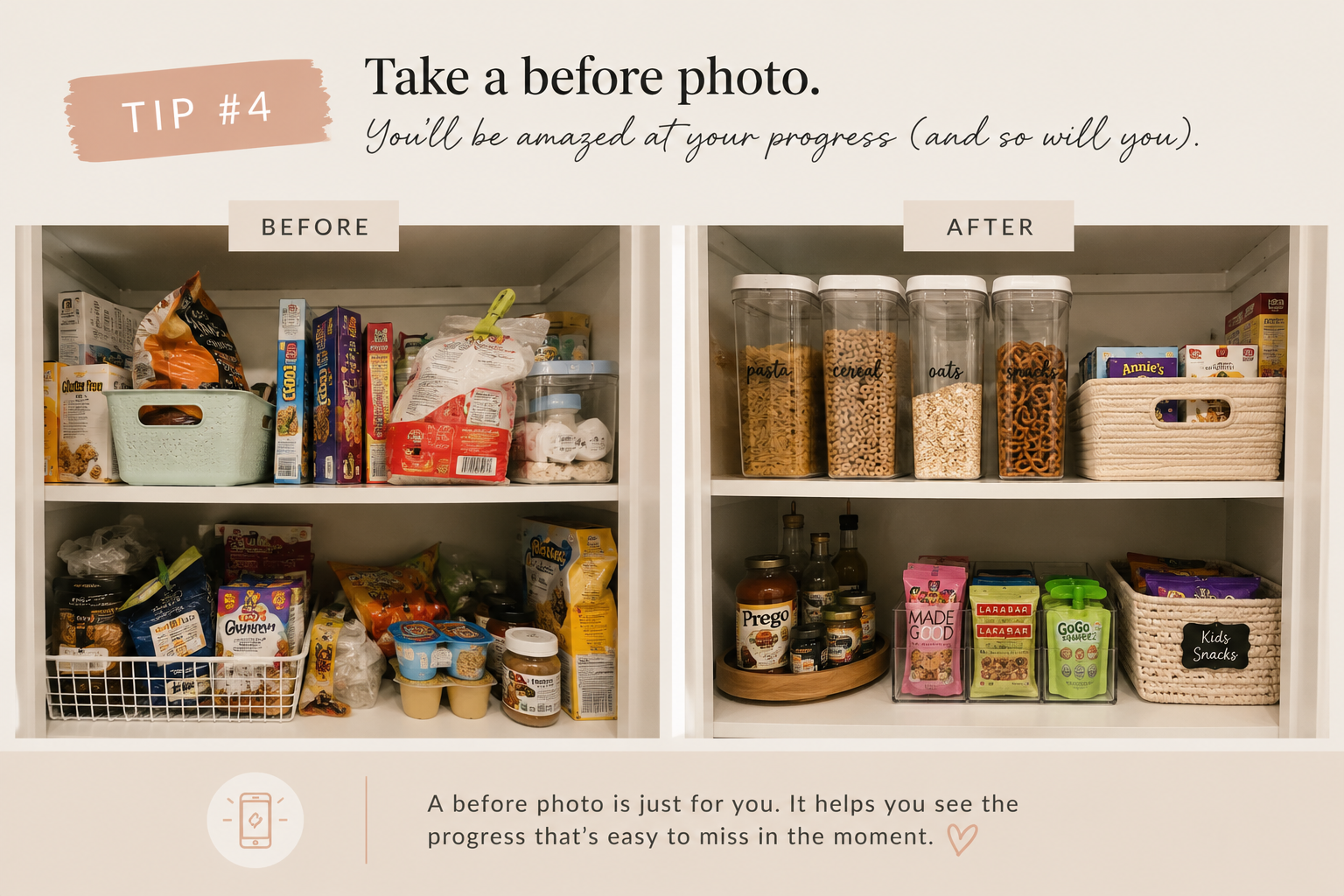
4. Take a “before” photo.
I know. You probably don’t want photographic evidence of the mess. Take the picture anyway.
And no, this isn’t for social media. It’s for you.
When you’re in the middle of an organizing project, it’s easy to focus on everything you haven’t finished. You might look around and think, “This still looks terrible,” even though you’ve actually made a lot of progress.
Maybe the counter was completely covered and now you can see it. Maybe the closet floor was buried and now you can walk into it. Maybe there were 47 toys on the floor and now there are 12. Progress doesn’t always feel obvious when you’re standing in the middle of it.
A before photo gives you something to compare your progress to. And if you eventually decide to bring in a professional organizer, that photo can also help me understand what we’re working with before we even get started.
5. Notice where things pile up—that’s data, not a personal failure.
This might be the most important one. If the same things keep ending up in the same place, pay attention.
Maybe shoes always pile up by the door. Maybe mail always ends up on the kitchen counter. Maybe laundry constantly lands on the chair instead of making it into the closet. Maybe your kids’ backpacks somehow live permanently in the hallway.That’s information.
Your clutter is often telling you something about your routines and your home. Maybe the system requires too many steps. Maybe the storage is inconvenient. Maybe there isn’t actually a designated home for that item. Or maybe the way your family uses the space has changed.
The problem isn’t necessarily that you’re “bad at organizing.” Sometimes the system simply doesn’t work for the way you actually live and that’s important information to have.
So… Do You Need a Professional Organizer?
Maybe. Maybe not. 🤷🏽♀️
If these five steps give you enough momentum to tackle your space yourself, I’m cheering you on. Seriously. Sometimes all you need is a starting point and permission to take it one small area at a time.
But if you try to get started and realize you’re still overwhelmed, don’t know where to begin, or keep reorganizing the same space over and over again, that’s where professional organizing can help.
A professional organizer isn’t there to judge your house or tell you that you have too much stuff. We’re there to help you figure out what isn’t working, what needs to change, and how to create systems that actually fit your real life.
And sometimes, getting there is easier with a little help.
Ready for some help getting started?
If you’re in the Locust Grove, McDonough, or Henry County area and you’re tired of feeling like your home is one more thing on your never-ending to-do list, I’d love to help.
And if you’re not quite ready to hire an organizer yet, that’s okay, too. Start with one drawer, one category, or one trash bag. You don’t have to organize your whole house today. You just have to start somewhere.